Critical Patch-Aware Sparse Prompting with Decoupled Training for Continual Learning on the Edge
Task-aware token sparsity and decoupled optimization for efficient prompt-based continual learning on resource-constrained edge hardware.
1.6x
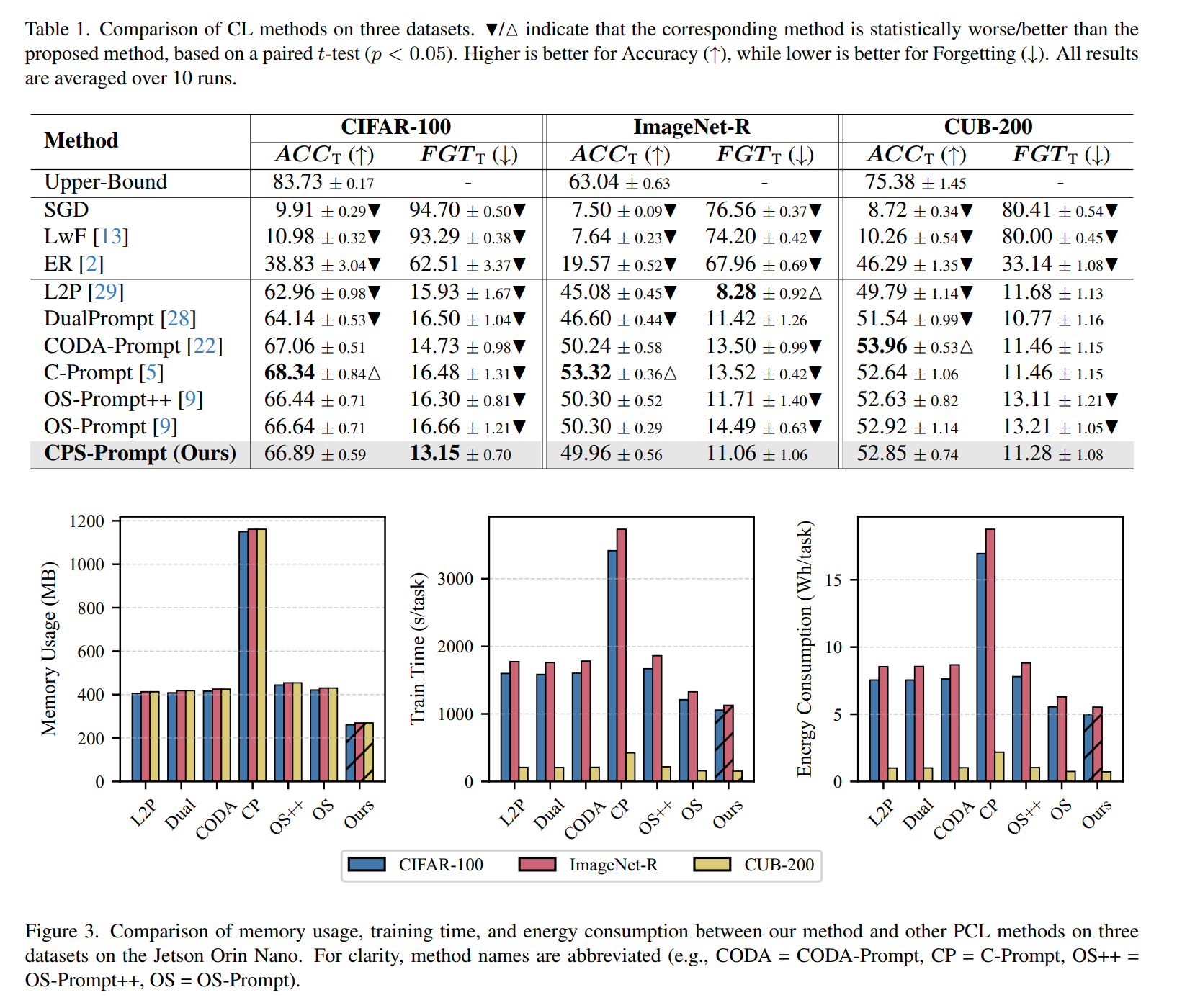
average improvement in peak memory, training time, and energy efficiency over CODA-Prompt
< 2%
average accuracy gap to state-of-the-art C-Prompt
3
benchmarks: CIFAR-100, ImageNet-R, and CUB-200
Jetson
edge-device measurements on NVIDIA Jetson Orin Nano
Abstract
Continual learning on edge devices requires high accuracy and training-time efficiency under strict memory and computation constraints. Prompt-based continual learning is parameter-efficient, but prior methods often prioritize accuracy or inference-time speed while overlooking the cost of on-device training.
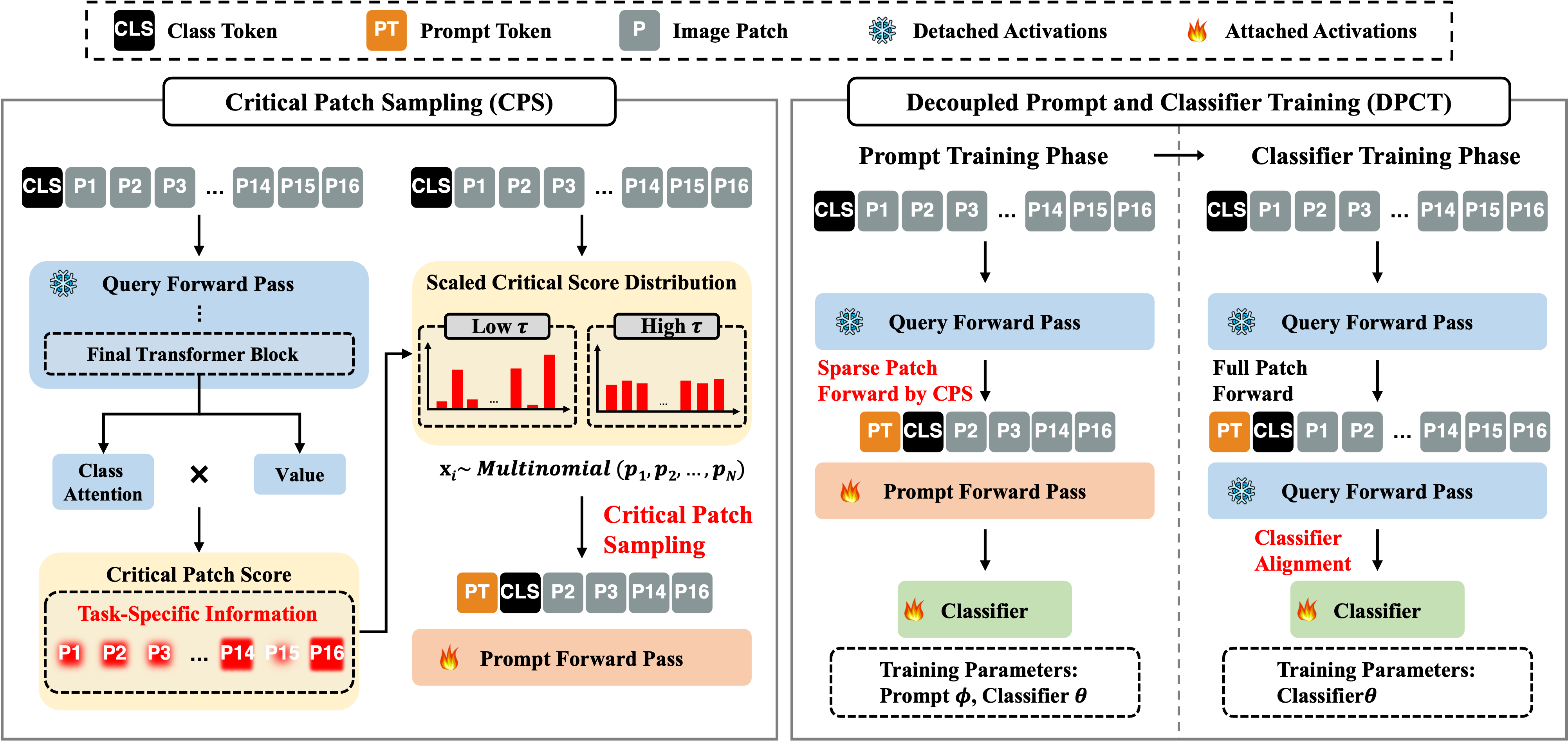
CPS-Prompt addresses this bottleneck with Critical Patch Sampling, which uses task-aware signals from the frozen query pass to keep informative patches, and Decoupled Prompt and Classifier Training, which reduces backpropagation overhead while aligning sparse training with full-patch inference. Across public benchmarks and real edge hardware, CPS-Prompt improves memory, time, and energy efficiency while maintaining competitive accuracy.
Method
Critical Patch Sampling computes patch importance from class-token attention and value norms in the final query transformer block. A temperature-scaled multinomial sampler retains a compact subset of task-relevant patches before the prompt-injected forward pass.
Decoupled Prompt and Classifier Training divides each task into a sparse prompt training phase and a full-patch classifier alignment phase. This reduces stored activations during prompt learning and mitigates the representation mismatch introduced by sparse inputs.
Results
CPS-Prompt is designed for the accuracy-efficiency trade-off that matters during continual training on edge devices.
Accuracy and Efficiency
CPS-Prompt remains competitive with CODA-Prompt and stays within about 2% average accuracy of C-Prompt, while substantially reducing peak memory, wall-clock training time, and energy consumption.
Task-Aware Sparsity
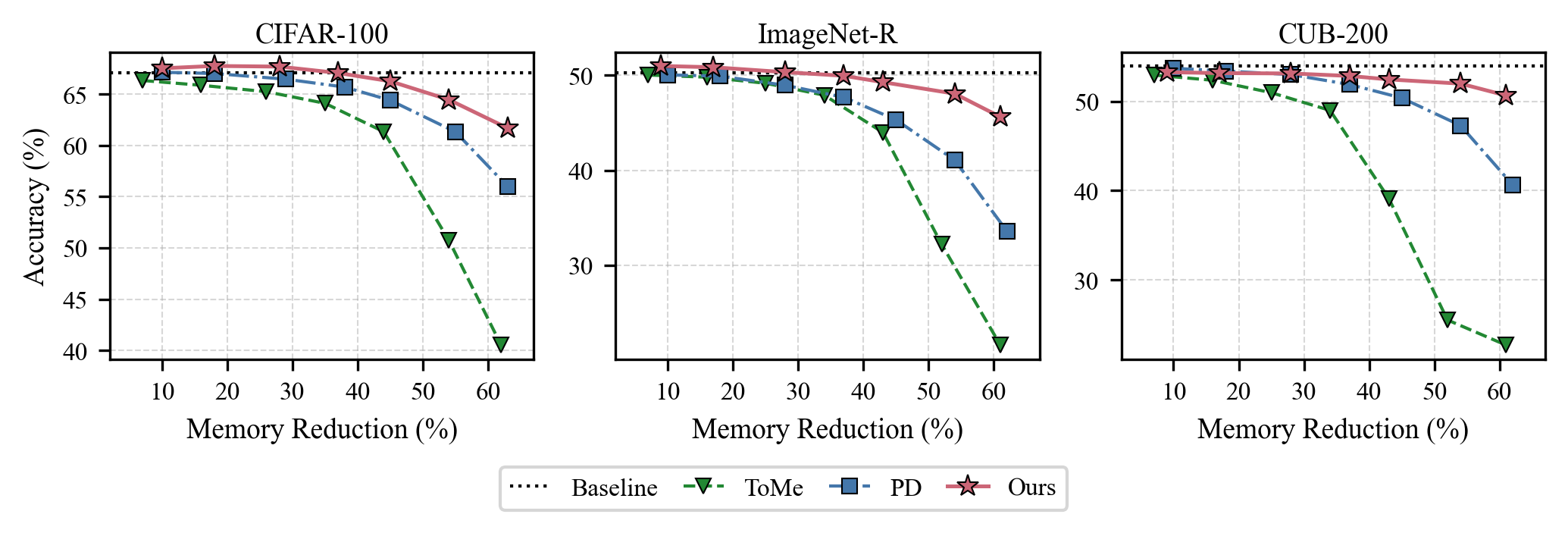
Compared with task-agnostic token reduction methods such as ToMe and PatchDropout, CPS-Prompt better preserves accuracy as memory reduction increases because patch selection follows task-relevant query signals.
Training-Time Scaling
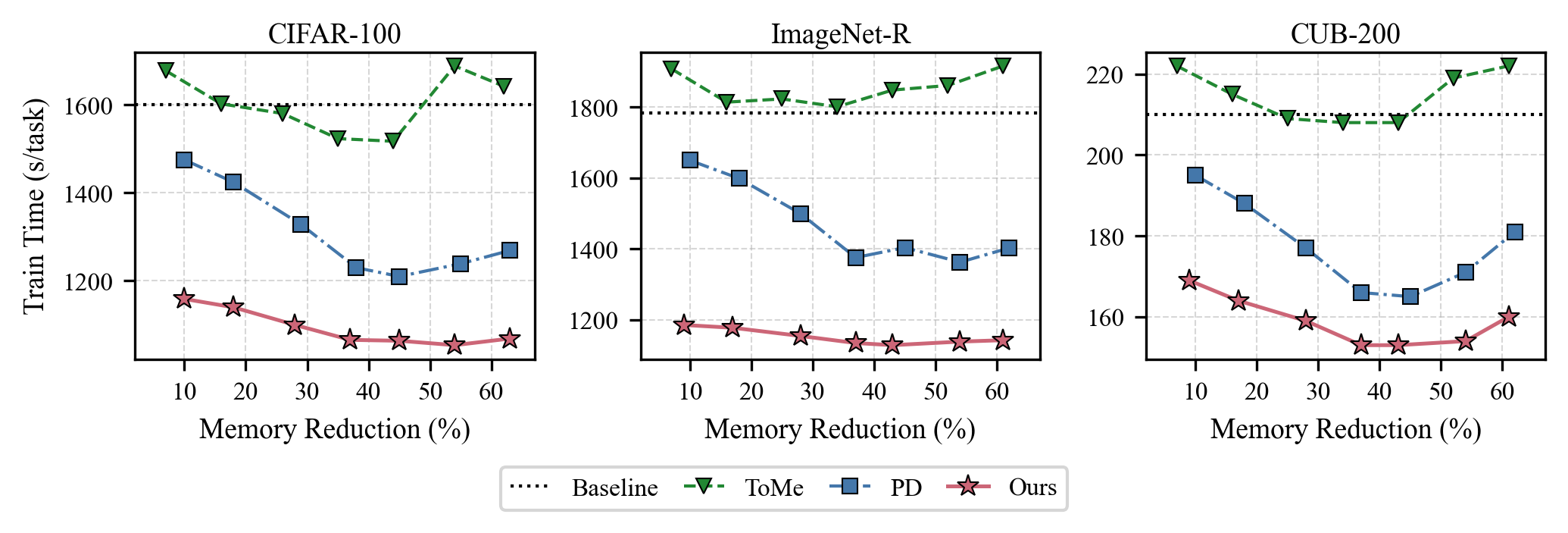
As patch reduction increases, CPS-Prompt lowers training time across benchmarks while maintaining a stronger accuracy-efficiency balance than task-agnostic token reduction baselines.
Ablation Signal
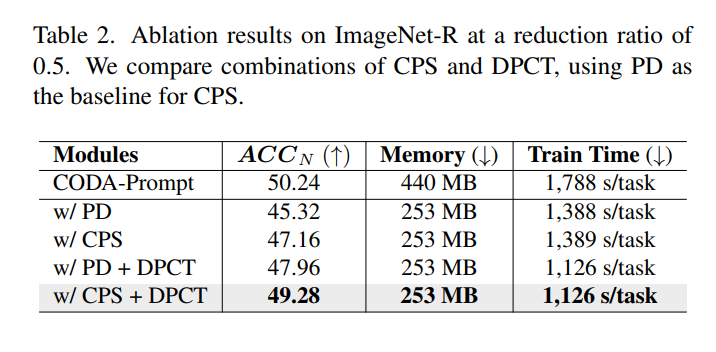
CPS improves over random patch dropping at the same memory usage, and DPCT recovers accuracy while lowering training time through classifier-only alignment.
BibTeX
@inproceedings{lim2026cpsprompt,
  title     = {Critical Patch-Aware Sparse Prompting with Decoupled Training for Continual Learning on the Edge},
  author    = {Lim, Wonseon and Lee, Jaesung and Kim, Dae-Won},
  booktitle = {Proceedings of the IEEE/CVF Conference on Computer Vision and Pattern Recognition (CVPR)},
  year      = {2026},
  url       = {https://arxiv.org/abs/2604.07399}
}